

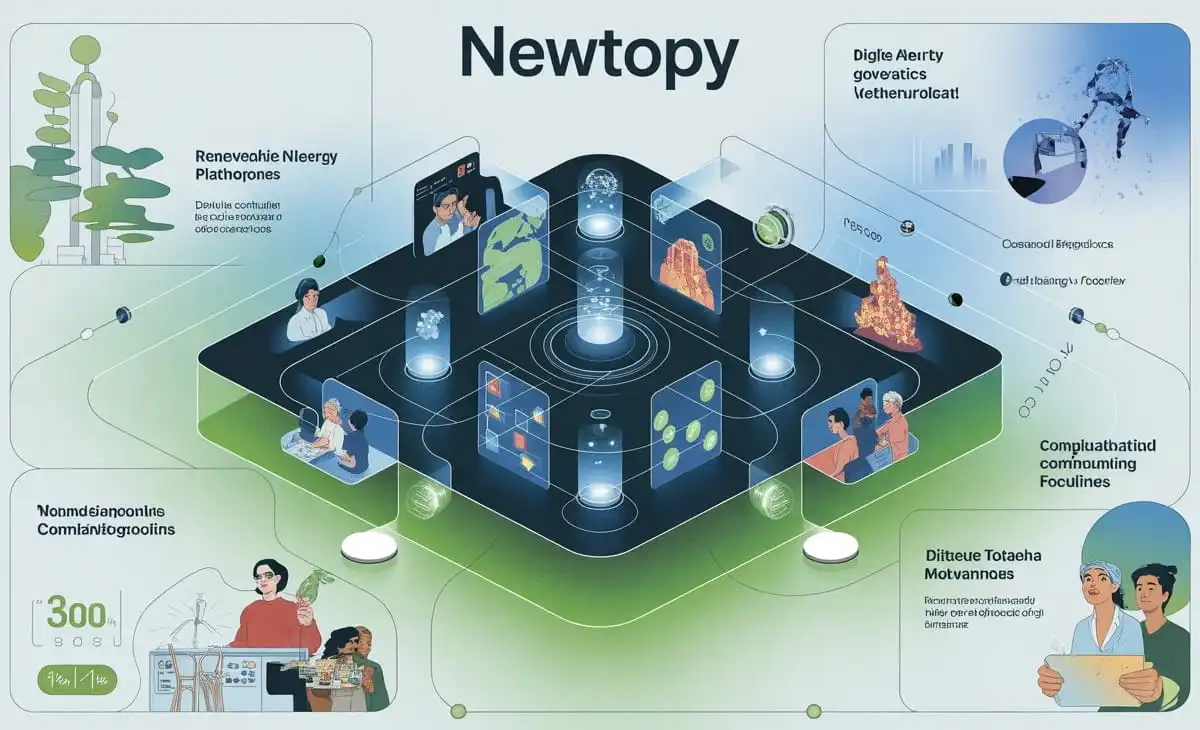
In a world shaped by rapid technological change, environmental pressure, and social transformation, Newtopy is emerging as a powerful idea for rethinking the future. Unlike traditional visions of utopia that imagine a perfect and unchanging society, it is rooted in reality. It focuses on practical evolution, ethical innovation, and collective responsibility rather than unreachable perfection.
It represents a mindset where humanity actively designs its future instead of passively inheriting it. It blends technology, culture, ethics, and collaboration into a flexible framework that can adapt as the world changes. This is why thinkers, innovators, and young leaders are increasingly drawn to the concept.
How Did the Concept of its Originate?
The term Newtopy is derived from the fusion of the words “new” and “utopy.” While classical utopian ideas imagined ideal societies frozen in perfection, it rejects the idea of a final destination. Instead, it embraces continuous improvement, experimentation, and learning.
The origin of Newtopy lies in modern challenges. Climate change, digital surveillance, economic inequality, and global crises have revealed the limits of old systems. Newtopy emerged as a response, encouraging people to rethink progress in a way that is adaptable, inclusive, and ethically grounded. It asks not what a perfect world looks like, but how a better world can be built step by step.
How Is Newtopy Different from Traditional Utopias?
Traditional utopias often fail because they ignore human complexity. They assume harmony without conflict and solutions without consequences. It takes a very different approach.
Rather than aiming for perfection, it accepts imperfection as part of growth. It focuses on evolution instead of static ideals. Like modern innovation models, it values feedback, iteration, and real-world testing. Where utopias stand still, Newtopy evolves. This makes it more realistic, resilient, and relevant to the challenges of the modern world.
How Newtopy Is Shaping Modern Thought and Innovation
It is increasingly influencing how people think about innovation. In technology, it inspires systems that prioritize human well-being, transparency, and ethical responsibility. Developers and researchers apply Newtopy thinking when designing AI that supports humans rather than controls them.
In urban planning, it encourages smart cities that balance technology with sustainability and community needs. In business and entrepreneurship, it supports models that focus on long-term social value rather than short-term profit. Across disciplines, Newtopy acts as a lens for reimagining progress.
Applications of Newtopy Across Society, Technology, and Economy
It does not belong to one field. It operates across multiple areas of life:
- In technology, it supports open-source systems, data ownership, and decentralized platforms
- In society, it encourages cooperative communities, inclusivity, and shared responsibility
- In economics, it promotes sustainable value creation over pure profit
Concepts such as decentralized organizations, regenerative agriculture, and ethical digital ecosystems align closely with Newtopy principles. Together, they represent a shift from extraction to regeneration.
The Role of Newtopy in Education and Culture
Education under the Newtopy framework moves beyond memorization. It emphasizes creativity, ethics, and problem-solving. Learners are encouraged to design solutions for real-world issues using interdisciplinary approaches.
Culturally, it connects with futurist movements that explore alternative futures through diverse perspectives. These cultural expressions do not simply imagine better worlds; they question who creates them and who benefits. This aligns with Newtopy’s emphasis on participation and shared authorship of the future.
Can Newtopy Transform Governance Systems?
One of the most transformative aspects of Newtopy lies in governance. It imagines systems built on transparency, decentralization, and citizen participation rather than rigid hierarchy.
Digital tools such as blockchain-based voting, AI-assisted policy analysis, and online civic platforms reflect this shift. In a Newtopy-inspired governance model, citizens are not passive voters but active contributors. Decision-making becomes collaborative, data-informed, and accountable.
Why Decentralization Is Central to Newtopy
Decentralization is a foundational principle of Newtopy. It reduces dependence on central authorities and distributes power across networks. This structure increases resilience and reduces the risk of abuse.
Examples include decentralized finance systems, community-owned energy projects, and federated social networks. These models allow communities to govern themselves while remaining interconnected. In Newtopy thinking, decentralization is not chaos; it is organized cooperation.
Criticisms and Challenges
Despite its promise, it faces criticism. Some argue that it underestimates real-world limitations such as inequality, access to technology, and political resistance. Others worry that multiple Newtopy models could fragment society.
Supporters counter that diversity is a strength rather than a weakness. Instead of one universal system, it allows multiple models to coexist and evolve. This flexibility helps prevent stagnation and encourages continuous learning.
How Youth Movements Reflect the Spirit of Newtopy
Youth-led movements around the world embody Newtopy in action. From climate activism to digital innovation communities, young people are redesigning systems instead of repairing broken ones.
They use technology as a tool for inclusion, transparency, and empowerment. Their approach combines idealism with practicality, reflecting Newtopy’s core principle: change is possible when imagination is paired with action.
Why Newtopy Is More Relevant Than Ever Today
Recent global crises have exposed the weaknesses of existing systems. Pandemics, environmental disasters, and economic instability have made it clear that old models are no longer sufficient.
It offers a way forward. It emphasizes resilience, interdependence, and collective intelligence. As individuals and organizations rethink their roles, it becomes a practical guide for navigating uncertainty and shaping sustainable futures.
Conclusion
Newtopy is not a distant dream. It is an invitation to actively design the present and future. It reminds us that progress is not automatic and that ethical choices matter.
Rather than promising perfection, it promises participation. It teaches that every innovation, decision, and collaboration contributes to the world being built. In an unpredictable era, it offers not certainty, but direction and that is what makes it powerful.
